Brief Biographies from the Jackson/Van Buren Era (B) :
Babbitt, Benjamin Talbot
1809-1889:
d.10/20
Son of a blacksmith born and raised in Oneida
County, NY. A mechanical genius who learned chemistry while a
mechanic in Utica by persuading a
professor from Hamilton College
to come there two evenings a week to lecture.
A successful businessman, partly due to shrewd advertising, and a friend
of P.T. Barnum's. Besides
manufacturing and improving all kinds of steam engines, farm equipment,
and ordinance for the Civil War, he made his "Babbitt's best soap" a household
name (one of his strokes of advertising genius was to make his soap factory
in New York, with its huge soap vats a tourist attraction.
He also involved his relative, Isaac
Babbitt, in soap manufacturing towards the end of the latter's life.
Babbitt, Isaac 1799-1862:
b.7/26,d.5.26
Inventor (in metallurgy, mostly) and manufacturer; born in Taunton
MA, with little education he became a goldsmith. He had success for
a while replicating and manufacturing "britannia ware", a cheap substitute
for silver in Taunton, but soon sold the works to their apprentices (it
became known as Reed and Barton, which continued in business).
In 1834, he went to Boston as superintendent of Alger's Foundry and
Ordnance Works, or the South Boston Iron Works, where he achieved great
success, casting the first brass cannon made in the United States. His
biggest success was the invention of a journal box (for enclosing train
axles, ball bearings, and lubrication), U.S. Patent #1252, 7/17/39, for
which he received large royalty fees. His suggestion of an alloy to be
used for the bearings, made parenthetically, was more important than the
invention itself (he is not regarded as the actual inventor or the alloy,
and presumably got no royalties from it).
Was committed to the McLean Asylum in Somerville,
MA towards the end of his life, and died there.
Source: DAB,
Oxford
Universal Dictionary.
Bache, Alexander Dallas
1806 - 1867:
Physicist born in Philadelphia. Proffessor from 1828-36 and 42-43, ind
in between, served as President of Girard College. One of the incorporators
of the Smithsonian Institute.
Bache, Benjamin Franklin
1769 - 1798 :
Grandson of Benjamin Franklin; founder of the Philla. General Advertiser,
later called the Aurora, which was very abusive to Federalists.
In June 1798 he was arrested under the Sedition law for libeling Pres.
Adams.
Bachman, John 1790 - 1874:
Lutheran minister born in Rhinebeck, NY. Became a naturalist and collaborated
with Audubon.
Bacon, Delia Salter 1811 - 1859
b.2/2, d.9/2
A very gifted woman who flourished briefly, from 1833 into the mid
40s, as a writer of historical fiction, and deliverer of lyceum-style lectures
and dramatic readings. Starting in 1845, a friendship, or romance, with
a Yale theology student 10 her junior led to scandal and humiliation, especially
when friends and family made a circus out of the attempt to vindicate her
honor. During her last few years, she alternated between mystic exaltation
and deep depression, while she traveled to England in an obsessive quest
to prove that Shakespeare's plays were in fact the work of Francis Bacon.
She died in an insane asylum in Hartford.
Her father was a Connecticut Congregational minister who moved to the
edge of the frontier in Ohio as a missionary to the Indians. He later tried,
unsuccessfully, to establish a sort of New England colony in Ohio (later,
others succeeded in this sort of endeavor). He died in 1817, and his children
had to be raised by various relatives.
For Delia, this meant growing up in Hartford
CT, in the home of a leading lawyer. At the age of 14, she spent a
year in Catharine Beecher's
Hartford Female Seminary, which accellerated her intellectual development,
and probably lead to the sort of intense Calvinist conversion experience
which Beecher (who struggled with her inability to have such an experience)
promoted among her pupils.
In 1847, as the unfortunate affair with Alexander MacWhorter was simmering,
she came strongly under the influence of her former teacher. Catherine
Beecher and brother Leonard.
Bacon, Francis 1561 - 1626:
Writer of Novum Organum (1620); credited with much influence in
the development of an inductive investigation of nature. Was regarded by
many early members of the British Royal Society as a mentor.
Bacon, Leonard (1802-1881):
Congregationalist minister, pastor of First Church, New Haven, Conn. from
1825. Helped found and edit The Independent. He seems to have had
a strong quarrel with Nathanial Taylor, an ally of Lyman
Beecher.
Several contributions from Bacon; footnotes and passages of text, appear
in the Autobiography
of Lyman Beecher (largely the work of Beecher's children).
Bailey, Gamaliel 1807-1859:
Antislavery advocate and editor of the Cincinnati
Philanthropist from 1836-46, the first antislavery paper in the
west. From 1847-59, edited the National Era, the publication of
the American and Foreign Anti-Slavery Society, which was put out in Washington,
DC.
Bainbridge, William 1774
- 1833:
Served as a naval officer in the war of 1812. Born in Princeton, NJ.
Baker, Benjamin A. 1818-1890:
Actor, playwright. Plays included A Glance at New York in 1848 and
New
York As It Is (both in 1848). Born in New York City.
Baker, Benjamin Franklin
1811-1889:
Established Boston Music School in 1857. Born Wenham, MA.
Baker, Geroge Augustus
1821-1880:
Portrait painter born in New York City.
Baldwin, Henry 1780 - 1844:
Pensylvania's member of U.S. House of Representatives from 1817-22. Associate
justice Supreme Court, 1830-44. Born in New
Haven, CT.
Baldwin, Joseph Glover
1815 - 1864:
b.1/?,d.9/30
"Born at Friendly Grove
Factory, near Winchester, VA".
He practiced law in the turbulent areas of Alabama and Mississippi from
1836-54. He went there to make his fortune having heard "most cheering
and exhilarating prospects of fussing, quarrelling, violation of contracts,
...". He "enjoyed throughly the brawling and practical joking, the tall
tales and extravagant oratory...", and portrayed it vividly his book, The
flush times of Alabama and Mississippi. (Source: The
flush times ... (Intro); DAB)
Baldwin, Matthias William
1795-1866:
Manufactured stationary steam engines from 1827 and locomotives from 1831.
Founded the M.W. Baldwin Company; later called the Baldwin Locomotive Works.
Born in Elizabethtown, NJ.
Ball, Thomas 1819-1911:
Sculptor born in Charlestown, MA. Did a lifesize bust of Daniel Webster
just before Webster's death. Other works portrayed Henry Ward Beecher,
George Washington; also Lincoln freeing a slave. The common thread seems
to be union and anti-slavery.
Ballou, Adin 1803-1890:
Founded the Hopedale Community in Milford Mass., which lasted from 1841-56.
Wrote Practical Christian Socialism in 1854, and Primitive Christianity
and its Corruptions in 1870. A Unitarian minister, born in Cumberland,
RI.
Ballou, Hosea 1771-1852:
One of the early leaders of the Universalist church in the U.S. Edited
Universalist
Magazine from 1819-28, and Universalist Expositor from 1830.
A great-uncle of Maturin Murray (Ballou), a founder and the first editor
of the Boston Daily Globe.
Bancroft, Aaron 1755 - 1839:
President from 1825-36 of the American Unitarian Association. Born in Reading,
MA.
Bancroft, George 1800-1891:
A historian on the fringes of the Transcendentalist movement. Published
a monumental and highly successful History of the United States,
which took 10 volumes and 40 years to complete. He was also an activist
in Jacksonian politics, receiving many givernment positions, including
ministry to Great Britain. Later he supported Lincoln and his successor,
Andrew Johnson.
Banvard, John 1815-1891:
Painter and writer born in New York City. In 1840, painted scenes along
the Mississippi, later to be made into a huge panoramic canvas which he
took on tour of the U.S. and England.
Barbour, James 1775 - 1842:
Governor of Virginia from 1812-15, Senator from 1815-25. Secretary of war
from 1825-28 under John Quincy Adams, then minister to Great Britain in
1828-9. Brother of Philip P (1783-1841)
Barbour, Oliver Lorenzo
1811-1889:
Compiled Reports of Cases in Law and Equity in the Supreme Court of
the State of New York (67 volumes for years 1847-77), known as _Barbour's
Supreme Court Report. Born in Cambridge, NY.
Barbour, Philip P. 1783-1841:
Became associate justice of the U.S. Supreme Court from 1836 until his
death. Brother of James (1775-1842).
Barker, James Nelson 1784-1858:
Mayor of Philadelphia 1819-20. Collector of the port of Philadelphia from
1829-38, under Jackson and Van Buren. Also produced plays, including
The
Indian Princess, or La Belle Sauvage in 1808.
Barnard, Frederick
Augustus Porter 1809-1889:
Class of 1828 at Yale. Taught from 1828-56, and was president and chancellor
of Mississippi University 1856-61, and president of Columbia U. from 1864-89.
Barnard College was name after him in honor of his advocacy of equal education
for women.
Barnard, Henry 1811-1900:
Advocate of improved public schools in Connecticut and Rhode Island from
1837-55. Born in Hartford CT; graduated yale in 1830. Headed St. Johns
College in Annapolis, MD rom 1866-7. Editor of the American Journal
of Education from 1855-82. Compiled the 52-volume Library of Education.
In 1867-70, he served as the first U.S. commissioner of education.
Barnes, Albert 1798-1870:
Presbyterian minister in Philadelphia from 1830-70. Born in Rome, NY.
Barney, Nathaniel:
With his wife Elizabeth, was one of
the hosts of the August, 1841 anti-slavery meeting which helped launch
the career of Frederick Douglass.
Barnum, Phineas T. 1810-1891:
Opened the "American Museum" in 1842. Like other museums of its time, it
was a hodge-podge of sensational curiosities, though perhaps grander. He
also took various of his curiosities, such as the midget Tom Thumb, and
a black woman supposed to be George Washington's (childhood) nurse, and
a "mermaid" on tours throughout the country. He went far out on a limb
financially to bring the phenomenal Swedish singer Jenny Lind on a tour
of the country. He later became a hugely successful circus impressario,
establishing "The Greatest Show on Earth", and then merging with another
circus man to form Barnum and Bailey Circus in 1881.
Born in Bethel, CT.
Barnum, Zenus 1810-1865:
Hotelkeeper (of the famous Barnum's Hotel in Baltimore?). Later in 1848-49,
organized a telegraph company to connect Washington and New York. This
merged, in 1859, with AT&T, and Barnum was made president.
Barry, William Taylor
1785 - 1835:
Postmaster General under Jackson from 1829-35. A lawyer by profession.
Born in Lunenburg, VA.
Bartlett, Enoch 1779 - 1860:
A merchant from Dorchester, Mass., for whom the Bartlett pear is named.
Bartlett, John Russell
1805-1886:
Bookdealer in New York 1836-50. Author of Dictionary of Americanisms
(1840), and the 10-volume Records of the Colony of Rhode Island, 1636-1792.
Bartlett, Samuel Colcord
1817-1898:
Minister and educator. Graduated Dartmouth in 1836. President of same from
1877-92.
Bates, Edward 1793-1869:
Born in Goochland County, VA. By profession a lawyer, he was Lincoln's
attorney General until 1864.
Bates, Frederick 1777 - 1825:
One of the first governors of Missouri, from 1824-5. Brother of Edward
(1793-1869).
BATES, Isaac Chapman, 1779-1845
Massachusetts Representative from 1827-35 (20th-23rd Congresses - he left
office voluntarily), and (Whig) Senator from 1841 until his death in 1845.
Also chairman of the Committee on Military Pensions in the 21st congress,
and Senate Chairman of Committee on Pensions in 27th-28th Congresses.
Born in Granville, Mass., January 23, 1779; tutored privately; was graduated
from Yale College in 1802; was admitted to the bar and commenced the practice
of law in Northampton, Hampshire County, Mass., in 1808. interment in Bridge
Street Cemetery, Northampton, Mass.
Bates, Joshua 1788 - 1864:
Partner in the international banking firm of Baring Brothers & Co.
from 1828-64. Chief founder of the Boston Public Library. Born in Weymouth,
MA.
BAYLOR, Robert Emmett
Bledsoe, 1793-1874
b.5/10,d.1/6
(nephew of Jesse Bledsoe) Representative from Alabama; born in Lincoln
County, Ky.; served in the War of 1812; studied law; was admitted to the
bar and practiced; member of the Kentucky house of representatives in 1819,
but resigned and moved to Alabama in 1820, continuing the practice of law;
studied theology, was licensed to preach, and was ordained to the Baptist
ministry; member of the Alabama house of representatives in 1824; elected
as a Jacksonian to the Twenty-first Congress (March 4, 1829-March 3, 1831);
unsuccessful candidate for election in 1830 to the Twenty-second Congress;
commanded an Alabama regiment during the Creek War; moved to Texas in 1839;
elected judge of the district and supreme courts of the Republic; member
of the convention that framed the State constitution of Texas in 1845;
district judge for twenty-five years; one of the founders of Baylor University
at Independence, Tex. (now located at Waco, Tex.), and Baylor Female College
at Belton, Tex.; professor of law in Baylor University; died at Gay Hill,
Washington County, Tex., on January 6, 1874; interment in the Baylor University
grounds; later the remains were removed to the campus of Baylor Female
College at Belton, Tex.
Source: Biog.
Dir. of Am. Congress.
Beach, Moses Yale 1800-1868:
Bought the New York Sun in 1838 and edited it until 1848 when he turned
it over to his sons Moses Sperry (1822-92) and Alfred Ely (1826-96).
Beale, Edward Fitzgerald
1822-1893:
Naval officer, courier, and scout. Crossed the country 6 times, including
once in 1848 to report the gold discoveries in California. Superintendent
of Indian Affairs for California and Nevada from 1852 - 65.
Beard, James Henry 1812-1893:
Born in Buffalo, NY, he set up an art studio in Cincinnati. Portrayed Henry
Clay, John Quincy Adams, Wm. Henry Harrison, and Zachariah Taylor.
Beaumont, Gustave
De La Bonniere 1802-1866:
Came to America with Alexis
de Tocqueville to study the penitentiary system of the United States,
about which they wrote a book (of course his partner wrote the much more
famous Democracy
in America).
Beaumont, William 1785 - 1853:
Surgeon, who essentially founded the medical scientific knowlege of the
process of digestion through his studies of man whose stomach was exposed
by a gunshot wound. Born in Connecticut.
Beck, Theodric Romeyn
1791 - 1855:
Co-wrote Elements of Medical Jurisprudence in 1822 with his brother
John Brodhead (1794-1851). Another brother, Lewis Caleb (1798-1853) wrote
on botony, chemistry, and mineralogy. Born in Schnenectady, NY.
Becknell, William 1790 - 1832:
(both dates are in question) Traced the Santa Fe trail, which helped establish
trade to the far southwest.
Beecher, Catharine Esther (1800-1878):
Successfully promoted higher education for women, but also the ideals of
Victorian domesticity. She engaged in strenuous public debates (in writing,
that is) with Angelica and Sarah
Grimke over their "improper" public roles. The Grimke sisters were
very active public speakers against slavery.
The Daughter of Lyman Beecher,
and sister of Catherine Beecher
Stowe and Henry Ward Beecher, Catherine
lost her fiance at sea, but received by his will a small fortune, which
she used to found the Hartford Female Seminary in
1823. The school was a celebrated success, and she went on to found
more schools, to write prolifically on education and woman's place in society.
Source: Sklar,
Kathryn Kish, Catharine Beecher
Beecher, Edward (1803 - 1895):
Studied at Andover and became pastor of Boston's Park St church in Boston
in 1826, just when his father, Lyman
Beecher was called to the Hanover Street church.
In 1831, became president of Illinois College, in Jacksonville where
he remained until called back to Boston to the Salem St. Church in 1844.
Like many of his generation, he was an enthusiast for many kinds of
reform, especially abolitionism.
He was close to Elijah Lovejoy
during the series of abolitionist agitations, and anti-abolitionist riots
that led to Lovejoy's shooting (defending his printing press). Beecher's
rather naive way of thinking permitted anti-abolitionists to attend and
totally disrupt the abolitionist convention which Lovejoy promoted in his
town of Alton, IL, and it is quite likely that this had a decisive impact
on the whole affair. After Lovejoy's death, Beecher was a leading force
in generating outrage at the event, especially among anti-slavery people
of all degrees of commitment, and proponents of freedom of speech.
Beecher also developed some very peculiar and controversial theological
ideas, which he put forth in his 1853 Conflict of Ages. He explained
man's depravity by a fall during our preexistence (a notion somewhat
akin to Mormon thinking), and claimed that the present world promised the
possibility of redemption for individuals and society as a whole, indeed
of building a perfect society.
He edited The Congregationalist from 1849 to 1852, and preached
in Illinois from 1855 to 1871.
[key facts taken from footnote to p 98 in the Autobiography
of Lyman Beecher].
Beecher, Henry Ward (Jun. 24, 1813 -
Mar. 8, 1887):
Anti-slavery minister and lecturer; son of Lyman
Beecher; brother of Harriet
Beecher Stowe and Catharine Beecher.
An 1834 graduate of Amherst
College, he first preached in the west, but in 1847, received a call
to be pastor over Plymouth Church, in Brooklyn NY, where he remained until
his death, gaining a tremendous (and controversial) fame.
Beecher, Lyman (Oct. 12, 1775 - Jan.
10, 1863):
One of the most popular and well-know ministers of his day. Father of
Harriet
Beecher Stowe, who wrote Uncle Tom's Cabin, of Henry
Ward Beecher, a very famous and influential anti-slavery minister before,
during, and after the Civil War, of Catherine
Beecher, an important educator, and of Edward
Beecher, first president of Illinois State College.
Born and raised in Connecticut, Lyman Beecher was the son and grandson
of a blacksmith. He studied theology at Yale under Timothy
Dwight and was ordained a Presbyterian minister. Between 1799 and 1810,
he ministered in E. Hampton, Long Island, NY. Long Island, opposite Long
Island Sound from Connecticut, was at the time, an outpost of New England
culture.
In 1806, he wrote a very celebrated sermon against dueling - largely
in reaction to the death of Alexander Hamilton in a duel with Aaron Burr.
The sermon was shortly published, and had a wide influence throughout the
country. It was directed squarely against a concept of "honor" which made
dueling a necessary recourse in certain situations. An excerpt from the
sermon:
The honor of a dueling legislator does not restrain him in the least
from innumerable crimes ... He may be ... in passion a whirlwind; in cruelty
to tenants, to servants, and to his family, a tiger. He may be a gambler,
a prodigal, a fornicator, an adulterer, a drunkard, a murderer, and not
violate the laws of honor. Nay, honor not only tolerates crimes, but, in
many instances, it is the direct and only temptation to crime.
Beecher also made some efforts towards starting anti-dueling societies.
Beecher's Autobiography
(p 108), states that an edition of 40,000 copies of the sermon were printed
by the Democratic party and scattered all over the North, when Henry
Clay was up for president (1836? or later?).
From 1810 until 1826, he preached in Litchfield
Connecticut. There he was close to New Haven
and the Yale professors of the "New Haven Theology", which injected some
optimism into the pessimistic Calvinist doctrines. Nathaniel
Taylor in particular influenced him. He was appalled by, and fought
against the disestablishment of the church in Connecticut, around 1820,
but later came to view it as a benefit to the church to be separated from
the government.
In helped found the American Bible Society and, in 1825, founded the
American Temperance Society, and so greatly influenced the strong temperence
movement that picked up steam in the 1830s and thereafter.
He was also appalled by the drift of Congregationist churches, especially
around Boston, towards Unitarianism, and some time in the 1820s(???)
started
the magazine Spirit of the Pilgrims, which tried to bring these
"sons of the pilgrims", among others, to the true light of his liberalized
Calvinism. In 1826, eager to battle the Unitarians in urbane Boston,
he answered the call to start a new Congregationalist church there.
He started out fighting the "New School" methods of Charles
G. Finney and his fellow evangelists, but came to respect Finney and
his methods, and later was accused of being a "New School" man himself.
In 1832, the wealthy reformers Arthur
and Louis Tappan of New York City,
former New Englanders themselves, wanted to establish a seminary in the
west, and got Beecher to be the first president of Lane Theological Seminary
in Cincinnatti, the "Queen City of the West".
In 1835, Beecher was tried by the Presbytery due to his supposed "new
school" theological heresies. In his "Autobiography"
(actually consisting of Beecher's biographical notes and correspondence,
tied together by much text written by Harriet
Beecher Stowe and his other children), one of his children asserts
that the trial "constituted the first shock of absolutistic theology
thoroughly aroused and reacting against the theology of moral government".
Perhaps
this is a good statement of the confusing conflict between the "new school",
or "new lights", interesting in saving as many souls as possible, and turning
the newly saved onto a path of good works, and the more traditional Presbyterians.
From 1850 until his death, he lived in retirement, in Brooklyn NY, with
his son, the famous minister Henry
Ward Beecher.
Beecher's "Autobiography"throws
a strong light on many of the tendencies in human thought and action in
his time, and many exciting events. It also gives a wonderful sense of
the vitality, the plain down-to-earth communication style, the dedication
and the lovability of Dr. Beecher.
Bell, James, 1804-1857
From Biog. Directory of American Congress:
Years of Service: 1855-1857; 1857-1857 Party: Opposition; Republican
(son of Samuel Bell, uncle of Samuel Newell Bell, and cousin of Charles
Henry Bell), a Senator from New Hampshire; born in Francistown, Hillsboro
County, N.H., November 13, 1804; attended Phillips Academy, Andover, Mass.,
and was graduated from Bowdoin College, Brunswick, Maine, in 1822; studied
law at Litchfield Law School, Litchfield, Conn.; was admitted to the bar
in 1825 and commenced practice in Gilmanton, N.H.; moved to Exeter in 1831
and to Gilford in 1846; member, New Hampshire house of representatives
1846-1850; delegate to the State constitutional convention in 1850; unsuccessful
candidate for Governor of New Hampshire in 1854 and 1855; elected as a
Republican to the United States Senate for the term beginning March 4,
1855, and served from July 30, 1855, until his death in Laconia, Belknap
County, N.H., May 26, 1857; interment in Exeter Cemetery, Exeter, N.H.
Pictured op. p238, Cleaveland and Packard.
Born in 1804 in Francestown, NH was the third son of
Samuel
Bell (see also Luther Bell, his younger brother Bowdoin 1823, p257
C&P, and pictured opposite that page) a distinguished citizen of NH,
having been a judge of the Superior Court, governor of the State (1819-23),
and senator in Congress (1823-35). His great-grandfather, John was
one of that famous Irish colony that settled Londonderry. His grandfather,
John, ended an honored and useful life at the age of ninety-five.
Maternally, James Bell came from the Danas. In college he was distinguished
by substantial scholarship and by his staid demeanor. His brother,
Samuel D. Bell of Concord, NH, now a judge of the Superior Court,
directed his early reading in the law, after which he attended the once
celebrated law school in Litchfield, CT. His first law office
was opened with characteristic modesty in Gilmanton, a small town of Stafford
County. But he could not keep concealed. His business soon
became extensive and important, and he removed in 1831 to Exeter.
He had not been here long before he took rank among the ablest lawyers
in the State. For several years scarcely a case of importance that
came within the range of his professional employment was tried in NH in
which he was not engaged. While he was thus in the full tide of success,
he accepted a proposition which led to a change of residence, and in some
measure, of pursuit. The manufacturing towns of Lowell, Lawrence,
and Manchester had for some time suffered much inconvenience and loss from
the diminished supply of water in the Merrimac during the dry season of
the year. To remedy this it was resolved to dam up the outlet of
the Winnipisaukee and other lakes, thus raising and retaining the waters
in these reservoirs of nature, to be let down at pleasure in time of need.
[ ....]
<elected to the senate in 1855, along with John Parker Hale (2nd
time for Hale) . They were both selected by the Native American caucus,
which dominated the NH legislature at that time. Bell's willingness
to sign a pledge to the Native American Party nearly derailed Hale's effort
(Hale would not get too close to the Native American Party) to get back
into the Senate, but a deal was worked -- there being two seats open, a
long-term one and a short-term one -- Hale got the short-term seat.
Bell died in 1857
Bell, John 1797 - 1869:
Served in U.S. House of Representatives from 1827-41 and the Senate from
1847-59. One of the nominees in the 4-way presidential race of 1860 which
put Lincoln in the White House. His party, the Constitutional Union Party,
was essentially the remnant of the Whigs which did not move over the the
Republican Party. Besides him and the main candidates, Lincoln and Douglas,
there was a radical pro-slavery faction of the Democratic party which got
most of the Southern votes.
From Biog. Directory of American Congress:
Years of Service: 1847-1855; 1855-1857;
1857-1859
Party: Whig; Opposition; American
(Know-Nothing)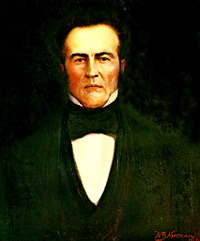
BELL, John, a Representative
and a Senator from Tennessee; born near Nashville, Tenn., February 15,
1797; was graduated from the University of Nashville in 1814; studied law;
was admitted to the bar in 1816 and commenced practice in Franklin, Tenn.;
member, State senate 1817; declined to be a candidate for reelection and
moved to Nashville; elected to the Twentieth, and to the six succeeding
Congresses (March 4, 1827-March 3, 1841); Speaker of the House of Representatives
(Twenty-third Congress); chairman, Committee on Indian Affairs (Twenty-first
through Twenty-sixth Congresses, except for Twenty-third), Committee on
Judiciary (Twenty-second and Twenty-third Congresses); appointed by President
William Henry Harrison as Secretary of War March 5, 1841, and served until
September 12, 1841, when he resigned; member, State house of representatives
in 1847; elected as a Whig to the United States Senate in 1847; reelected
in 1853, and served from November 22, 1847, to March 3, 1859; unsuccessful
candidate in 1860 for President of the United States on the Constitutional
Union ticket; investor in ironworks at Cumberland Furnace in Chattanooga,
Tenn.; died at his home on the banks of the Cumberland River, near Cumberland
Furnace, September 10, 1869; interment in Mount Olivet Cemetery, near Nashville,
Tenn.
Bibliography
DAB; Parks, Joseph H. John Bell Of Tennessee. Baton Rouge:
Louisiana State University Press, 1950.
Bell, Samuel, 1770-1850
Years of Service: 1823-1825; 1825-1829; 1829-1835 Party: Adams-Clay
Republican; Adams; Anti-Jackson
(father of James Bell, grandfather of Samuel Newell Bell, and uncle
of Charles Henry Bell), a Senator from New Hampshire; born in Londonderry,
N.H., February 9, 1770; attended the common schools and New Ipswich Academy;
graduated from Dartmouth College, Hanover, N.H., in 1793; studied law;
was admitted to the bar in 1796 and commenced practice in Francestown,
N.H.; moved to Amherst, N.H., in 1810 and to Chester, N.H., in 1812 and
continued the practice of law; member, State house of representatives 1804-1807,
serving as speaker 1805-1807; member, State senate, serving as president
of that body 1807-1809; member, state executive council 1809-1811; judge
of the State supreme court 1816-1819; Governor of New Hampshire 1819-1823;
elected to the United States Senate in 1823; reelected in 1829, and served
from March 4, 1823, to March 3, 1835; was not a candidate for reelection
in 1834; chairman, Committee on Claims (Twenty-third Congress); affiliated
with the Whig Party upon its formation in 1834; retired to his farm; died
in Chester, N.H., on December 23, 1850; interment in the Village Cemetery.
Bibliography
DAB.
Bellows, Henry Whitney
1814 - 1882:
Unitarian minister in New York City from 1839 - 82. Founder and president
of the U.S. Sanitary Commission. Active in civil service reform.
Beman, Nathan Sidney
Smith 1785 - 1871:
Presbyterian (New school) minister.
Benedict, Erastus
Cornelius 1800 - 1880:
Author of American Admiralty, a standard text on naval law. Born
in Branford CT.
Benjamin, Ashre 1773 - 1845:
Architect and populariser of of the late colonial style. Born in Greenfield,
MA.
Benjamin, Judah P. 1811 -
1884:
Born in the British West Indies of Jewish parents but mostly raised in
Charleston, SC. Senator from Louisiana from 1853-61. Attorney general in
Confederate cabinet; then served in the departments of war and state. Advocated
arming the slaves to fight for the Confederacy.
Benjamin, Park 1809-1864:
Editor and minor poet. Grew up in Connecticut.
Bennett, James Gordon (Sep. 1, 1795
- June 1, 1872):
Founder of the New York Herald in 1835. A huge success estimated
to be worth $500,000 - $700,000 a year at his death.
He was born in Scotland, came to Halifax, Nova Scotia in 1819, and Boston
in 1822 (where he became a proofreader). He spent some of the next couple
of years in Charleston, SC, making translations from the Spanish for the
Charleston
Courier.
Proprietor of the New York Courier, in 1825 but not successful
with that.
Benson, George W. :
"Lawyer turned businessman from Brooklyn,
CT". His father founded an anti-slavery society in Providence
RI; his sister married Wm.
Lloyd Garrison in 1834.
In 1841, he and others founded the Northampton Association, a commune
which tried to support itself by silk production (in what became Florence,
MA, near Northampton).
source: Painter,
Sojourner Truth; Christopher
Clark, Communitarian Moment.
Benson,
Samuel Page, 1804 -1876
Picture opp p 291, C&P.
Representative from Maine, born in Winthrop (few miles east of the
Kennebec), Maine, November 28, 1804. His "worthy father", Dr. Peleg
Benson, was native of Middleboro MA, settled in Winthrop in 1792.
Mother was Sarah, daughter of COl. Simon Page of Kensington NH. received
instruction from private teachers and attended the Monmouth (Maine) Academy
("fitted for college by Mr Joslyn" - C&P); was graduated from Bowdoin
College, Brunswick, Maine, in 1825; studied law (under Gen. Benson and
Samuel S. Warren of China ME); was admitted to the Kennebec County bar
in 1828 and commenced practice in Unity (Waldo County), Maine; returned
to Winthrop (after just 2 yrs acc to C&P) and practiced law until 1850
(C&P: Returned that he might be near his aging parents... worked "with
many interruptions to which he submitted with a patient grace that showed
he was not all a lawyer" -- school committees, agricultureal
societies, academy and college boards contrived to get a great deal of
work out of him). Soon after the death of his wife in 1848, B discontinued
his legal practice and devoted himself to railroad business and agricultural
pursuits; secretary of the Androscoggin & Kennebec (later Maine Central)
Railroad; member of the State house of representatives in 1833 and 1834;
served in the State senate in 1836 and 1837; secretary of state 1838-1841;
overseer of Bowdoin College 1838-1876 and president of the board for sixteen
years; chairman of the board of selectmen 1844-1848; elected as a
Whig to the Thirty-third Congress and as a Republican to the Thirty-fourth
Congress (March 4, 1853-March 3, 1857)( would seem to
put him at loggerheads with Frank Pierce); chairman, Committee
on Naval Affairs (Thirty-fourth Congress) C&P:
"During the memorable 9 wks struggle for a speaker Mr. Benson acted as
one of the tellers, and we can have no reason to suppose he felt badly
[to] announce the election of Mr. Banks. ... has long presided
over the board of overseers of Bowdoin Coll.
Was not a candidate for reelection in 1856; resumed the practice of
law; married 2nd time 1872 to Esther, daughter of late Dr Eleazer Burbank
of Yarmouth. Died in Yarmouth, Cumberland County, Maine, August 12,
1876; interment in Maple Cemetery, Winthrop, Maine.
Biographical Dir. of Am Congress, and C&P,
p291.
Bent, Charles 1799 - 1847
A fur trapper in what would become Colorado and New Mexico, far beyond
the settled territory of the U.S. Born in Charleston VA (now in WV).
Bentham, Jeromy 1748 - 1832:
Defined utility as "the greatest happiness of the greatest number", and
called this the criterion for ethics (utilitarianism).
Benton, Thomas Hart (Mar. 14, 1782 -
Apr. 10, 1858):
Powerful Senator from Missouri from 1821(?) until 1851, and a congressman
for one term after that.
Born in Hillsboro, NC, and educated at the University of North Carolina,
at Chapel Hill, he went to Tennessee to make a career of law. During the
War of 1812, he became a Colonel of militia, but a quarrel and eventual
gunfight with Andrew Jackson led
to the end of his military career.
He moved then to St. Louis, in the then territory of Missouri. He practiced
law there, and established a newspaper, the Missouri Inquirer. He,
partly through the paper, actively advocated statehood, and in 1821 or
22 became one of the state's first Senators. He remained in the Senate
for 30 years, after which, in 1854, he published his Thirty
Years View, describing his experences and observations, and later,
an Abridgement
of the Debates of Congress, from 1789 to 1856, in 8 volumes.
Bergh, Christian 1763 - 1843:
Opened a shipyard on the East River, New York City around 1785, and ran
it until 1837. Father of the founder of the ASPCA (founded 1866).
Berrien, John Macpherson
1781 - 1856:
Native of NJ; elected Senator from Georgia in 1824. Resigned the Senate
in 1829 to be Jackson's Atty General, but in June 1831 was forced to leave
that position over the Eaton
affair. Served in the Senate again as a Whig 1841-1852. "a man of commanding
personal appearance, a learned and skilful advocate, and an orator of unusual
power". (Source: DAB)
Bethell, John:
Invented the pressure process, pattented in 1838, for impregnating wood
with preservatives - used especially for railroad ties.
Betts, Samuel Rossiter
1786 - 1868:
Judge know for his decisions on admiralty law.
Bibb, George Mortimer
1776 - 1859:
U.S. Senator from KY from 1811-14 and 1829-35. Secretary of the treasury
from 1844-5. Born in Prince Edward County, VA and became a lawyer.
Biddle, James 1783 - 1848:
Naval officer who became prominent in the War of 1812. Negotiated in 1846,
the first treaty between the U.S. and China.
Biddle, Nicholas 1786 - 1844:
Director of the Bank of the U.S. from 1819 - 1839. Brilliantly gifted,
but fought against Andrew Jackson's dismantling of the bank using tactics
that only seemed to prove Jackson's point - that the bank was an immensely
powerful potential or actual instrument of corruption that was not accountable
to the people.
Bidlack, Benjamin Alden
1804 - 1849:
American diplomat who in 1846 negotiated a treaty with Columbia which included
the right to build the Panama Canal. Born in Paris, NY.
Bigelow, Erastus Brigham:
Inventor of power looms. Born in West Boylston, MA.
Bigelow, Jacob 1786 - 1879:
Physician and Botonist who wrote on medicinal plants. Born in Sudbury MA.
Bigelow, John 1817 - 1911:
Partner with William Cullen Bryant in the New York Evening Post from 1848-61.
Later a diplomat and historic writer.
Bingham, George Caleb
1811 - 1879:
Western genre painter. His "Stump Speaking" is used for the cover art of
Cmiel, Democratic
Eloquence. Another, "County Election", with some of the same characters
in it, is on the cover of Gatell, Essays
on Jacksonian America.
Bingham, Caleb 1757 - 1817:
b.4/15,d.4/6
Writer of early American textbooks.
Born Salisbury, CT. Dartmouth
College 1779-1782 (Valedictorian, at age 25). Kept an Indian charity
school which was connected to Dartmouth, then conducted a private school
for "young ladies" in Boston.
First textbook - 1785, was The Young Lady's Accidence or a Short
and Easy Introduction to English Grammar: Designed Principally for the
Use of Young Learners, more especially of the Fair Sex, though Proper for
Either. This enjoyed a long and wide popularity.
1789(-96?) - spent 7 years working for Boston public schools.
Two of his books, in particular: The American Preceptor (1794),
and The Columbian Orator (1797), had a major effect on American
education, replacing bible-reading as the primary instructional reading
matter, and "for a quarter of a century, especially in the district schools,
... surpassed in popularity all their competitors".
The Columbian Orator went through many editions in which its
content continually changed. Frederick
Douglass obtained a copy early in his youth, having learned to read
semi-secretly, and gave it much credit for developing his style, and inspiring
him to be an orator.
Source: DAB;
McFeely,
Douglass.
Bingham, Hiram 1789-1869:
Missionary to Honolulu (1820-40). Devised a written form of the Hawaiian
language, and, with others, translated the Bible.
Binney, Horace 1780 - 1875:
Lawyer and legal writer
Bird, Robert Montgomery
1806 - 1854:
b.2/5,d.1/23
Born in Newcastle DE, after
desultory schooling, he attended medical school, becoming an M.D. in April,
1827. He "disliked taking fees", and so did not last long as a practicing
physician (later, in 1841, he became a professor at the Pennsylvania Medical
College). After writing several plays, he obtained a huge success with
The
Gladiator, sponsored by, and starring, Edwin Forrest.
Birkbeck, Morris 1764 - 1825
:
Helped promote Illinois as an emigration destination in England, with his
Notes
on a Journey in America (1817), and Letters from Illinois (1818).
This resulted in a venture with George
and Richard Flower
that resulted in the founding of Albion
IL.
Birney, James Gilespie (1792
- 1857):
Sone of a slaveholder in Kentucky. Educated in law(?). Converted to wholehearted
abolitionism by Theodore Weld.
Executive secretary, American Anti-Slavery Society 1837ff. Liberty Party
candidate for president in 1940 and 43(?). Father of James Birney(1817-88),
and William (1819-1907) and David Bell (1825-64), both of whom became Civil
War generals.
Bissell, George H. 1821-84:
Organized the first oil company in the U.S.
Black Hawk 1767 - 1838:
Sauk Indian chieftan who, after being forced
to take his people across the Mississippi River, and being unable to find
or produce enough to eat there, mounted raids on Illinois and Michigan
territory. Dictated his Autobiography through interpretors in 1833.
Black, Adam 1784 - 1874:
Scottish publisher and owner of rights to Encyclopaedia Britannica
and the Waverley Novels by Sir Walter Scott.
Blair, Francis Preston
Blair, Montgomery 1813 - 1883:
Lincoln's postmaster general. Born in Franklin County, KY
Blanchard, Thomas 1788 - 1864:
Invented an automatic tack-manufacturing machine, a lathe for turning gun
barrells, and other devices. Born Sutton, MA.
Blatchford, Samuel 1820 -
1983:
Associate justice Supreme Ct. 1882 - 93.
Blenkinsop, John 1783 - 1831:
Englishman. Patented (1811) a kind of steam engine for use on locomotives.
Bloomer, Amelia Jenks
1818 - 1894:
Activist for women's rights and education reform. Her name became synonymous
with the full trousers that were part of the "reformed" dress for women
that she advocated. Born in Homer, NY. Maried Dexter C. Bloomer in 1840
Blount, William 1749-1800:
First U.S. Senator from Tennessee, and prior to statehood, governed a large
territory which included Tennessee. He was a patron of the young Andrew
Jackson.
Bogardus, James 1800 - 1874:
Inventor born in Catskill, NY. Invented gas meter.
Boggs, Lillburn W. 1792 -
1860:
Governor of Missouri from 1836-40. Drove the Mormons out of Missouri.
Bolivar, Simon 1783 - 1830:
Led much of South America in revolt against the Spanish colonial government.
Babies and towns were named in his honor in the U.S.
Bond, Shadrach 1773? - 1832:
First governor, from 1818-1822, of the state of Illinois. Born in or near
Baltimore, Maryland, he settled in Illinois around 1791.
Bond, William Cranch 1789
- 1859:
Director of the Harvard (astronomical) Observatory 1839 to 1859.
Bonneville, Benjamin
Louis De 1796 - 1878:
Army officer who explored the northwest. Born in Paris, France. He also
served in the war with Mexico and the Civil War. Washington Irving described
his northwestern exploration (Adventures of Captain Bonneville)
in 1837.
Boone, Daniel 1734 - 1820:
Guided many settlers into the territory soon to become the state of Kentucky,
and helped secure the settlers against the Indians.
Booth, John Wilkes 1838 - 65:
Well known Shakespearean actor, best known as the assassin of Abraham Lincoln.
Booth, Junius Brutus 1792
- 1852:
A famous English actor who settled in the U.S. in 1821. Father of John
Wilkes Booth. Subject to fits of insanity.
Borden, Gail 1801 - 1874:
Inventor of methods of preserving food, like condensed milk, and a "meat
biscuit". Born in Norwich, NY, he wandered west, settling in Texas around
1829.
Bouboulina, Laskarina
1783 - 1825:
Heroine of the Greek war for independence which was highly popular in the
U.S. She armed three ships, commanded them against the Turks in 1823. She
was eventually killed in action.
Boucicault, Dion 1820 - 1890:
Playwright and actor born in Dublin. Came to America in September 1853,
where he lived until 1862 (shortly after his 1859 play, The Octoroon).
He lived 10 years in London, and returned to the U.S. to stay the rest
of his life. "It may be said that more than any other one man he kept the
American drama lively and popular during the mid-19c".
Source: DAB.
Bourne, Hugh 1772 - 1852:
English - founder of the Primitive Methodists in 1810, after he was expelled
from the main branch of Methodists.
Bouvier, John 1787 - 1851:
Italian-born jurist. Settled in America in 1802, and practiced law in Philadelphia
from 1822. Wrote Law Dictionary ... in 1839, and The Institutes
of American Law (4 volumes) in 1851.
Bowditch, Nathaniel 1773
- 1838:
Wrote and/or edited important works on astronomy and navigation. Born in
Salem, MA.
Bowen, Francis 1811 - 1890:
Philosopher and professor at Harvard 1853-..
Bowen, George 1816 - 1888:
Missionary to India from 1848.
Bowie, James 1799 - 1836:
Early settler in Texas, a colonel in the Texas army (of settlers, mostly
from the U.S. in revolt against Mexico) and one of the group killed in
the Alamo. Born in Burke County, Georgia, and supposed to be the inventor
of the Bowie knife.
Bowles, Samuel 1797 - 1851:
Publisher of the weekly Hartford Times from 1819-22; founder of
Springfield Republican, a weekly from 1824-44 and daily thereafter.
Born in Hartford, CT.
Boyden, Seth 1788 - 1870
Invented process for making patent leather in 1819; malleable cast iron
and sheet iron; a hat-shaping machine. Manufacturer of steam engines.
Boye, Martan Hans 1812 - 1909:
Danish-born scientist who came to the U.S. in 1836. Discovered nickel deposits
in Pennsylvania. Devised process for extracting cottonseed oil.
Boyer, Jean Pierr 1776 - 1850:
President of Haiti from 1818-46. A free mulatto. Driven out by revolution.
Brace, Charles Loring
1826 - 1890:
One of the founders of the Children's Aid Society (1853). Born in Litchfield,
CT.
Bradburn, George (anti-nativist)
? - ?:
A Nantucketer well known for
anti-nativism, and a (minor, apparently) abolitionist. Present 1/29/42
at the meeting at Faneuil Hall to receive an anti-slavery petition signed
by 60,000 Irishmen, including notably Daniel
O'Connell.
Bradbury, James Ware 1802-1901:
Years of Service: 1847-1853 Party: Democrat
Born in Parsonsfield, Maine, June 10, 1802; attended the common schools
and Gorham Academy; was graduated from Bowdoin College, Brunswick, Maine,
in 1825; principal of Hallowell Academy and founder of the first normal
school in New England, at Effingham, N.H., in 1829; studied law; was admitted
to the bar and commenced practice in Augusta, Maine, in 1830; prosecuting
attorney 1834-1838; elected as a Democrat to the United States Senate and
served from March 4, 1847, until March 3, 1853; declined to be a candidate
for reelection; chairman, Committee on Printing (Thirtieth Congress), Committee
on Retrenchment (Thirty-first and Thirty-second Congresses); trustee of
Bowdoin College 1861; president of the Maine Historical Society 1867-1887;
practiced law in Augusta, Maine; died in Augusta, Maine, January 6, 1901;
interment in Forest Grove Cemetery.
Bibliography
DAB.
Bradley, Joseph P. 1813 -
1892:
Associate justice on Supreme Court from 1870 to his death.
Bradshaw, George 1801 - 1853:
Englishman who initiated the publication of railway timetables in 1839;
also a well-know series of railway guides.
Brady, Mathew B 1823 - 1896:
Photographer famous for his civil war pictures, and portraits of Lincoln.
Bragg, Braxton 1817 - 1876:
Confederate general and adviser to Jefferson Davis. Graduated West point
in 1837. Brother of Thomas (1810-72).
Bragg, Thomas 1810 - 1872:
Attorney general of the Confederacy from 1861-2. Brother of Braxton.
Brainard, John
Gardiner Calkins 1796 - 1828:
Poet and associate editor of the Connecticut Mirror from 1822 -
27.
Branch, John 1782 - 1863:
Secretary of the navy under Jackson from 1829 until 1831, when he was forced
to resign, along with most of the cabinet, due to the feud between the
Calhoun and Van Buren factions, and the Peggy Eaton imbroglio. Previously
Governor of North Carolina (1817-20), and U.S. Senator from 1823 to 29.
He was governor of the Florida Territory from 1834-45.
Brannon, Samuel 1819 - 1889:
Led a colony of Mormons to California in 1846 after adopting the faith
in 1842. Published the first newspaper in San Francisco - the California
Star, beginning 1847.
Breckennridge, John C.
1821 - 1875:
Ran for President in the 4-way race with Lincoln, Douglas, and John Bell.
He stood for the southern pro-slavery Democrats. Joined the Confederate
Army in its first year of existence. Became secretary of war of the CSA
in 1865.
Breen, Patrick ? - 1868:
Irish-American who imigrated in 1828. One of the 26 (out of 81) survivers
of the Donner party, who were caught in a blizzard in November 1846, on
their way to California. His diary depicts the awful affair in detail.
Brewer, Thomas Mayo 1814
- 1880.
Ornithologist.
Brewster, Benjamin
Harris 1816 - 1888:
U.S. Attorney General from 1881-85
Bridger, James 1804 - 1881:
Pioneer and scout - first to visit the Great Salt Lake. Born in Richmond,
VA.
Brigham, Amariah 1798 - 1849:
Founded the American Journal of Insanity in 1844 (now called the
American
Journal of Psychiatry).
Brisbane, Albert 1809 - 1890:
Born in Batavia, NY, he wrote the
Social
Destiny of Man in 1840, and other works, promoting Fourierism, an elaborate
theory and blueprint for communal living in communities called Phalanxes.
Bronson, Tillotson ? - ?
Uncle of Amos Bronson Alcott (his
mother Anna's brother - she is said to have put him through Yale
with her sewing). Ran the Episcopal
Academy of Connecticut. Boarded Alcott for a couple of months, and
later, boarded (1819-21) Gideon Welles
as he spent a couple of not very productive years at the academy. (Source:
Niven,
Welles,
p9-10; and Shepard, Pedlar's
Progress)
Brooks, Peter Chardon
1767 - 1849:
Reputed to have been the "wealthiest man in New England", upon his death.
He gained his initial wealth from insuring ships and from the East Indian
trade, but after the very early 1800s, compounded his money through judicious
loans.
Father-in-law of Charles
Francis Adams and of Edward
Everett, whose public careers, Brooks' money helped to support.
Source: DAB.
Brooks, Preston Smith (Aug 5, 1819 - Jan
27, 1857):
Served in the House of Representatives for South Carolina from 1853 - July
15, 1856, when he resigned after the House refused to expell him over his
assault on Charles Sumner. He was then elected in August 1, 1856 to fill
the vacancy caused by his own resignation.
Brooks was born in Edgefield district, SC, in the upcountry, graduated
South Carolina College (Now U. of SC) 1839, and was admitted to the bar
in Edgefield in 1845. He served as captain in the Mexican-American War.
In 1841, he and another eventually well-known Southern fire-eater named
Louis Wigfall shot each other in a duel. Both survived.
Brown, Benjamin Gratz
1826 - 1885:
Involved in the formation of the free-soil party in Missouri (of all places),
and later in the formation of the Republican Party. Governor of Missouri
from 1871 - 73. Horace Greeley's running mate for president in 1872.
Brown, Francis 1784 - 1820:
President of Dartmouth College
from 1815 - 1820, during the historic Dartmouth College Case, which did
much to establish the permanence of government (whether state or federal)
compacts with individuals and corporations.
Brown, Goold 1791 - 1857:
Born in Providence, RI. In 1823, published Institutes of English Grammar.
Brown, Henry Kirke 1814 -
1886:
Made equestrian sculptures of Washington, Gen. Winfield Scott, and Gen.
Nathanael Greene. Born in Leyden, MA.
Brown, James 1800 - 1855:
Boston publisher. Begun in 1837 the partnership which became Little, Brown,
and Company.
Brown, John (1800 - 1859):
In the chaos of "bloody Kansas", in which abolitionists and pro-slavery
men rushed in to try to set up a free or slave state, Brown massacred five
pro-slavery men at Pottawatomie (May 24, 1856), then made a "heroic stand"
against the Missouri slavery adherants at Osawatomie (August, 1856). All
this followed a tour of the east in which he collected money for firearms.
October 16-17 1859, he seized the federal arsenal at Harpers Ferry (in
Virginia, now West Virginia), with some of his sons and a handful of black
men, and a plan, of sorts, to unleash a war of slaves against their owners.
Captured by Colonel Robert E. Lee.
In his trial for treason (for which he was hung Dec. 2, 1859), he used
the defense to make highly effective propaganda, and was seen by many in
the north as a martyr, which in turn infuriated many in the south.
Brown, Joseph Rogers 1810
- 1876:
Developed precision instruments for drawing and measurement. Cofounded
J.R. Brown & Sharpe in 1853 - later named Brown and Sharpe Manufacturing
Co. Born in Warren, RI.
Brown, Nicholas 1729 - 1791:
Manufactured cannons for the American Revolution. Helped found the college
in Rhode Island which is named for him (was called Rhode Island College
up to 1804). Born in Providence, RI.
Brown, Solymann 1790 - 1876:
Congregational preacher from 1813-17, classics teacher from 1820-32, and
Swedenborgian minister from 1822. Organized the profession of dentistry.
Born in Litchfield, CT.
Browne, Charles Farrar
1834-1867:
Humorist who wrote under the name of Artimus Ward. A favorite of Abraham
Lincoln. Born near Waterford, MA.
Browning, Orville
Hickman 1806 - 1881:
Senator from 1861-63 and secy of interior 1866-9. Born in Harrison County
KY.
Brownlow, William
Gannaway 1805 - 1877:
Methodist minister and a Whig editor in the heart of Jackson country. Edited
the Wig and Independent in Jonesboro TN from 1839-49, and Knoxville Whig
from 1849-61. A leader of southern unionists. Governor of Tennessee from
1865-69; senator from 1869-75. Born in Wythe County, VA.
Brownson, Orestes (1803-1876):
One of the transcendentalist circle, for a few years, before converting
to Roman Catholocism in 1844 and leaving all that behind.
He was a universalist minister from 1826-29, and a Unitarian minister
from 1832-44.
He participated in the Brook Farm experiment.
Sources:
Bryant, William Cullen
1794 - 1878:
While practicing law from 1815-25, he began publishing poetry. The author
of Thanatopsis, he is one of the best of the early American poits.
Beginning in 1829 he turned to newspaper publication, and co-owned and
co-edited the New York Evening Post until 1878. He continued to
publish a little bit of poetry.
Buchanan, Franklin 1800 -
1874:
Drew up the plan of the Annapolis naval school of which he was the first
superintendent. Later an admiral in the Confederate Navy. Born in Baltimore.
Buchanan, James 1791 - 1868:
President of the U.S. from 1857-61. A Pennsylvanian, he graduated Dickenson
College in 1809, practiced law, volunteered in the war of 1812, and practiced
law again. He served in the House of from 1821-31, during which time he
became a strong Jacksonian. Russian minister from '32-'34, then a senator.
Secretary of state under Polk, and in 1853-6, Minister to Britain.
When Abraham Lincoln ran for Senator against Douglas in 1858, he kicked
off his campaign with the rousing "House Divided" speech, in which he warned
that the half slave and half free division of the country would have to
be resolved some day, and that Buchanan and others "Steven (Douglas), Franklin
(Pierce), Roger (Taney), and James (Buchanan)", appeared to be erecting
for us an all-slaveowning "house". When Lincoln was elected president two
years later, and southern states prepared to leave the union, Buchanan
appeared to accept the nation's splitting apart, and did nothing to try
to prevent it.
Buckley, Samuel Botsford
1809 - 1883:
A naturalist, and, in the 60s and 70s, a prominent geologist in Texas.
Buckner, Simon Bolivar
1823 - 1914:
West Point class of '44, and a confederate Lieut. General. Later, governor
of Kentucky from 1887-91. He was born in Hart County, KY.
Buckstone, John Baldwin
1802 - 1879:
Wrote comic plays in England - including Luke the Labourer and
Ellen
Wareham.
Buell, Don Carlos 1818 - 1898:
Became a major general in the Civil War, but was dismissed in October 1862
for the too-common (for Union generals) failing of letting a defeated enemy
army retreat in safety.
Bulkeley, Peter 1583 - 1659:
First minister and first civic leader of Concord, MA.
Bullfinch, Charles 1763-1844:
A great American architect, born in Boston and Harvard educated, who did
much to improve the appearance of Boston and of Washington, DC, where He
was official architect from 1817 - 1830.
Bullock, James Dunwody
1823 - 1901:
Navy officer and agent to England for the Confederacy.
Bulmer, William 1757 - 1830:
English publisher of a famous edition of Shakespeare.
Bunting, Jabez 1779 - 1858:
English secretary of Wesleyan Missionary Society for 18 years.
Burchard, Samuel
Dickinson 1812 - 1819:
Presbyterian minister in New York City from 1839 to 1879. Coined the phrase
"rum, Romanism, and rebellion" to described the Democrats in the 1880s.
Burleson, Edward 1798 - 1851:
Texas pioneer, from 1831, and a general in the Texas Revolution of the
1830s.
Burlingame, Anson 1820 - 1870:
Member House of Representatives from 1855-61.
Burnett
(Or Burnet), Peter Hardeman 1807 - 1895:
First governor of the state of California (1849-51). Born in Nashville
TN.
Burney, Fanny 1752 - 1840:
Englishwomam who wrote the novels Cecilia, Camilla, and
The
Wanderer.
Burns, Anthony
(runaway slave in Boston)? - ?:
A cause celebre when, on 5/24/1854, he was
seized by the federal marshall to be returned to slavery. Theodore
Parker was among those who tried, unsuccessfully, to free him by force
from the court.
Burnside, Ambrose Everett
1824-1881:
West Point class of '47. Commanded much of the seige of Petersburg. Popularized
"burnsides" or "side burns".
Burr, Aaron 1715/16 - 1757
Pastor of First Church, Newark, NJ,
from 1836-1857. Son-in-law of Jonathan
Edwards, through his marriage (at age 36) to Esther Edwards on 6/29/1752.
He was acting president of the College of New Jersey (Princeton)
from late 1747, and officially so, from 1748, at which time the college
was moved to Elizabethtown (now
Elizabeth), NJ to his pastorage in Newark.
Burr, Aaron 1756 - 1836:
Officer in the revolution; Vice President in Jefferson's first term; for
several years a force in New York state politics until his killing Alexander
Hamilton in a duel made him unpopular. Tried for suspicious, seemingly
treasonable activities in the West, he was acquitted by the Supreme Court,
and went back legal practice in New York City, where he cut an urbane figure.
Burritt, Elihu 1810 - 1879:
"The Learned Blacksmith" - he founded and edited a weekly called Christian
Citizen to spread the gospel of world peace. Organized a peace confrence
in Brussels in 1848. Born in New Britain, CT.
Bushnell, David 1742 - 1824:
Invented a sort of primitive submarine.
Bushnell, Horace 1802 - 1876:
Congregational minister in Hartford
Connecticut from 1833 - 1861. A liberal, writer, and advocate of widespread
education.
Butler, Andrew Pickens
1796 - 1857:
The uncle of Preston S. Brooks, a senator from 1846-57, whom Charles Sumner
took severely to task during the days of "Bloody Kansas", and for whom
Brooks inflicted permanent injuries by caning on Sumner.
Butler, Benjamin Franklin
1818 - 1893:
Lawyer, politician, and Civil War officer. He became military governor
of New Orleans in 1862, and was hated for his severity. Born in Deerfield,
NH.
Butler, Elizur ? - ?:
Missionary to the Cherokee Indians. Imprisoned in the early 1830s in Georgia,
with Samuel A. Worcester,
when the two refused to swear allegiance to the state of Georgia, as Georgia
tried to force white persons living in the Indian territories within the
Georgia boundaries to do.
Butler, Pierce 1744 - 1822:
South Carolina senator elected 1789; reelected; resigned 1796. Irish-born.
Father-in-law of James Mease,
and grandfather of the Pierce Butler
who married Fanny Kemble.
Butler, Pierce 1810 - 1867:
Born as Butler Mease, son of James
Mease, and also grandson of the elder Pierce
Butler. In spring 1834, he married Fanny Kemble.
He grew up in Philadelphia, and changed his name as a precondition to receiving
a large inheritance from his maternal grandfather. When the Philadelphia
boy moved to his huge inherited slave plantation in Georgia, he took to
plantation farming, but his wife detested it, a source of some of the marital
friction that eventually separated them.
Butler, William Orlando
1791 - 1880:
Lawyer, army officer, and running mate of Lewis Cass in 1848. Born in Jessamine
County, KY.
Butterfield, Daniel 1831
- 1901:
Civil War general. Fought at Gettysburg and Chattanooga and with Sherman
in his march to the sea.
Bynum, Turner ? - 1832:
Editor in the early 1830s (and perhaps previously) of the Greenville
Sentinel, a nullification paper. Bynum challenged his fellow Greenville
editor Benjamin
F. Perry to a duel over a political disagreement, and was fatally wounded
by Perry. (Source: Freehling, Prelude
to Civil War, p252).